

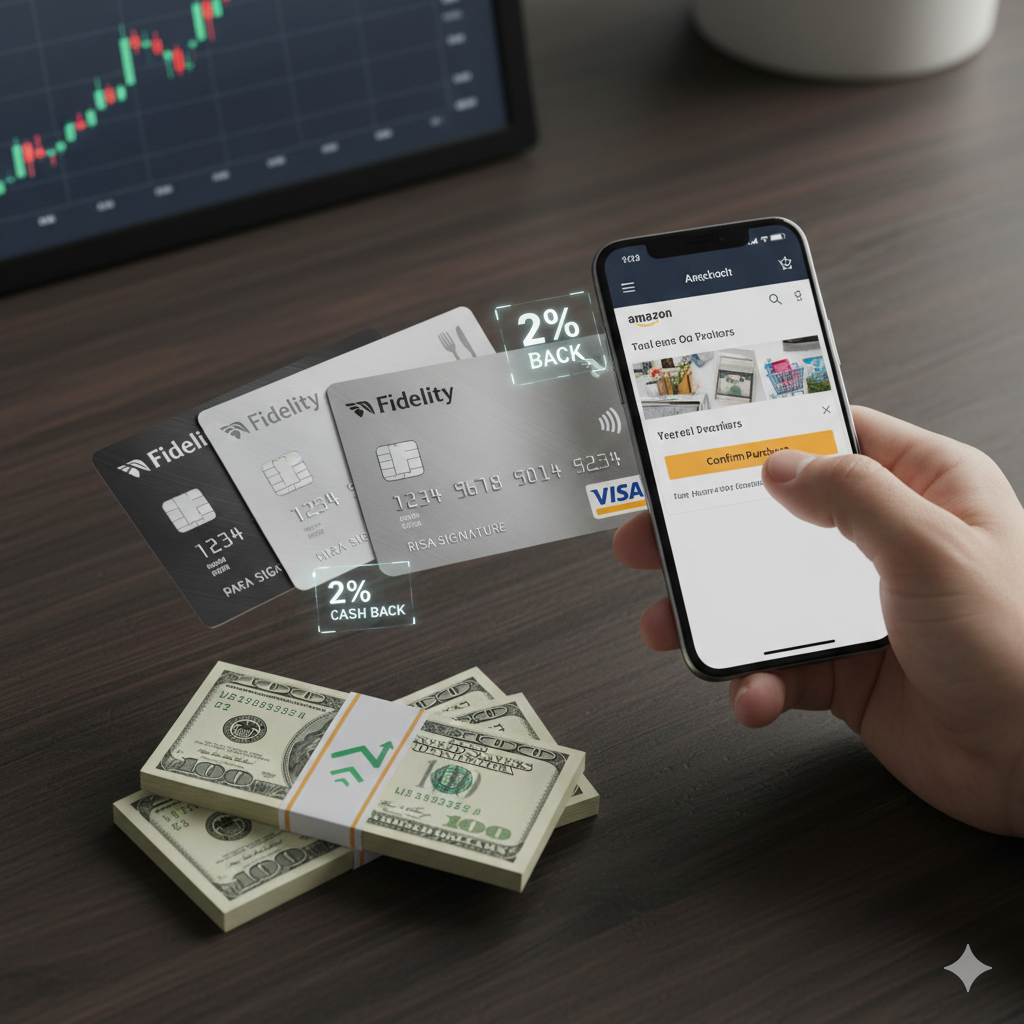
Have you ever wished your credit card did more than just take your money? Most of us are used to the standard “spend and pay” cycle, maybe catching a few points along the way. But the Fidelity Rewards Visa Signature Card is one of the most underrated tools in the market because it’s designed to do something different: it can actually grow your money while you spend.
Now, before you rush to apply, it’s not for everyone. There are specific “gotchas” and downsides you need to know about to ensure you’re actually getting ahead. In this review, I’m going to go over the rewards, the hidden travel perks, and my honest take on whether this card earns a permanent spot in your wallet for 2026.
💰 The Rewards: 2% That Can Turn Into Much More
Let’s start with the basics. This card is a heavy hitter in the “flat-rate” world. You earn an unlimited 2% cash back on every single purchase. There are no rotating categories to track, no “opting-in” every quarter, and no caps on how much you can earn.
Here is how the math breaks down:
-
For every $1 you spend, you earn 2 points.
-
1,000 points = $10 (when deposited into a Fidelity account).
-
So, if you spend $2,000 a month on bills, groceries, and gas, you’re looking at $40/month or $480/year in your pocket.
The “Hidden” 6% Travel Bonus
There is a bit of a “secret” feature that cardholders have been buzzing about in 2026. While it’s not always front-and-center on the public website, many users report seeing a 6% cash back offer on hotels and car rentals when booked through the Fidelity Rewards Center. It seems to be a targeted or member-only portal perk. If you’re a traveler, that 6% rate easily beats out almost every other “free” card on the market.
🌍 Premium Travel Perks (For $0 Annual Fee)
Usually, to get “Signature” benefits, you have to pay a hefty annual fee. But the Fidelity Visa has no annual fee, yet it still packs in perks that help frequent flyers:
-
TSA PreCheck/Global Entry Credit: You get a $100 credit every four years to cover your application fee. If you’ve ever stood in a 45-minute security line, you know this is pure gold.
-
No Foreign Transaction Fees: You can use this card in Paris, Tokyo, or Kampala without being hit by those annoying 3% “international” surcharges.
-
Auto Rental Coverage: It offers secondary coverage up to $75,000 for damage or theft. Just make sure to pay for the entire rental with your Fidelity card and decline the rental agency’s collision damage waiver.
-
Travel & Emergency Assistance: Access to a 24/7 concierge and emergency help (like ticket replacement or legal referrals) while you’re away from home.
📈 The “Magic” of Automated Investing
What really makes this card stand out is the redemption strategy. While you can redeem for gift cards or statement credits, I strongly advise against it. Why? Because the value per point often drops below 1 cent.
To get the full 2%, you need to deposit your rewards into an eligible Fidelity account (Brokerage, Roth IRA, HSA, or 529 Plan).
How Your Cash Back Compounds
When you use Auto-Redeem, your points land in your account and go into a “core position”—currently a Money Market fund earning roughly 3.96% APY.
If you take it a step further and invest that $40 a month into the stock market (averaging an 8% return), your “2% card” effectively becomes much more over time. Check out how the math stacks up over 10 years:
| Timeframe | Cash Only (2%) | In Money Market (~4%) | Invested in S&P 500 (~8%) |
| 1 Year | $480 | $490 | $500 |
| 5 Years | $2,400 | $2,600 | $2,900 |
| 10 Years | $4,800 | $5,900 | $7,300 |
By simply living your life and paying your bills with this card, you’ve turned “spare change” into $7,300 without ever thinking about it. This is the definition of passive wealth building.
⚠️ The Downsides (The Dealbreakers)
No card is perfect, and there are four things that might make you say “pass”:
-
No Sign-Up Bonus: Unlike the Wells Fargo Active Cash or Citi Double Cash, which often offer a $200 bonus, Fidelity usually offers $0 to start. You have to spend $10,000 just to “catch up” to a card that gave you a $200 head start.
-
No 0% APR Intro: If you need to carry a balance for a few months to pay off a big purchase, this isn’t the card for you. The interest will instantly wipe out your 2% rewards.
-
Fidelity Ecosystem Required: To get the full 2%, you must have a Fidelity account. If you’re a die-hard Vanguard or Schwab fan, opening another account might feel like a chore.
-
Credit Score: This is a “Signature” card, meaning they generally look for Excellent credit (720+). It’s not a “starter” card.
🏁 Is It Worth It?
The Fidelity Rewards Visa is worth it if:
-
You are already a Fidelity customer (or don’t mind becoming one).
-
You want a simple, “one-and-done” card for every purchase.
-
You love the idea of your rewards being automatically invested to grow for your future.
Skip it if:
-
You are chasing a $200 sign-up bonus today.
-
You prefer to keep your cash back in a standard checking account at a different bank.
-
You enjoy “gamifying” your rewards by switching between five different cards for different categories.
At the end of the day, this card turns “spending” into “saving.” It’s a tool for the disciplined person who wants their money to work as hard as they do.
Why I Use a 2% Cashback Card for Everything Else (My Real Strategy)
For a long time, I thought I had my credit card strategy completely figured out.
I had:
-
One card for travel
-
One for dining
-
One for groceries
-
One for gas
I felt organized. Strategic. Optimized.
But then I noticed something.
There were still tons of purchases that didn’t fit neatly into any of those bonus categories.
Amazon orders.
Random online subscriptions.
Household items.
Unexpected expenses.
And those were quietly earning… just 1%.
That’s when I decided to use a flat 2% cashback card as my “everything else” card — specifically the Fidelity Rewards Visa Signature Card.
And honestly? It completed my system.
How I Actually Use It
Here’s exactly how my setup works:
-
Travel → travel rewards card
-
Dining → dining card
-
Groceries → grocery card
-
Gas → gas card
-
Everything else → 2% Fidelity card
Most of that “everything else” ends up being Amazon purchases. I don’t use an Amazon-branded card, so instead of settling for 1% on those purchases, I consistently earn 2%.
It doesn’t sound dramatic.
But over time? It adds up.
Why I Prefer 2% Over Complicated Rewards
There’s something freeing about a flat-rate card.
No rotating categories.
No activation required.
No mental math at checkout.
If it’s not clearly earning 3–5% somewhere else, I default to 2%.
That means I never earn just 1% again.
And that small difference compounds more than most people realize.
If you spend $1,500 per month on miscellaneous purchases:
-
1% = $15
-
2% = $30
That’s $180 extra per year just for using the right card.
Now imagine investing that.
The Bigger Picture: Why This Fits My Investing Mindset
I’m not chasing hype rewards.
I’m building systems.
And this card fits into that mindset perfectly:
-
Maximize bonus categories where possible
-
Use 2% as the fallback
-
Keep it simple
-
Let the returns stack quietly
It’s not about getting rich from cashback.
It’s about not leaking money through 1% default rewards.
Who This Strategy Works Best For
This approach makes the most sense if:
-
You already use category-specific cards
-
You want a reliable fallback option
-
You prefer simplicity over constant optimization
-
You like the idea of investing your cashback
It might not be ideal if you:
-
Only want travel points
-
Prefer premium perks over cashback
-
Don’t want multiple cards
